You're training. Working hard. Showing up.
So why do you feel awful?
Because looking fit is not the same as being healthy. And most men are flying blind without the dashboard that actually matters.
I know, because I was one of them.
The Moment Everything Changed
A few years ago, I was standing in the bathroom after a huge week. Shoulders tight, lower back aching, mentally foggy.
I was training hard. Really hard.
But I looked in the mirror and realized something that stopped me cold:
"I'm doing all this work…but I have no idea if it's actually working."
No clarity. No indicators. No feedback loop.
I was flying a plane without instruments. Driving at night without headlights. And hoping effort alone would be enough.
That day triggered the creation of what I now call the Strong Body Dashboard. It's completely changed the way I train, recover, age, and perform.
Because here's the truth most fitness influencers won't tell you:
"You don't rise to the level of your goals. You fall to the level of your metrics."
And that's why these five numbers matter more than how much you can bench press or how many miles you can run.
We're Entering a New Era
Your wearable now knows more about your body than your doctor sees in a standard check-up.
And the men who thrive over the next decade won't be the ones who "train harder."
They'll be the ones who track what matters.
Because most men are still guessing. Still hoping. Still training blind.
As I got older and life became fuller (business, marriage, responsibilities, pressure) I realized something most men discover too late:
Looking fit is not enough. Training hard is not enough. Motivation is definitely not enough.
If you want long-term strength, health, and energy, you need a dashboard.
You wouldn't fly a plane without instruments. You wouldn't drive at night without headlights. So why are so many men trying to "wing it" with their body?
Why This Matters for Men Over 30
As I moved into my 30s, I noticed the gap widening between two types of men I grew up with.
Same age. Same starting point.
One group is getting stronger. The other is slowly declining.
And the difference isn't genetics.
It's awareness.
Some men realise something early: If you taper effort, you don't stay the same, you slide backward.
That awareness creates clarity. "I can't be casual about the things that matter."
Clarity creates direction. Direction creates momentum.
And momentum is what creates real confidence.
Not hype. Not motivation. Proof.
That's why I get men to track five simple metrics. Because what you track, you don't drift from.
Let me show you exactly what they are and why they matter.
The Five Numbers
1. Resting Heart Rate (RHR): Your Recovery Baseline
This is your body's idling speed. A strong RHR indicates long-term health and how well you're recovering.
Most men sit around 60-70 beats per minute. If you're training consistently, you should be closer to 55. Elite athletes? They're down at 45-50. That's where your body is truly efficient.
Typical ranges for men:
- Average: 60-70 bpm
- Good: 55-60
- Great: 50-55
- Elite: 45-50
If your RHR jumps 8+ beats above your baseline, something is off: stress, inflammation, poor sleep, or sickness creeping in.
This single number can save you from weeks of burnout.
Here's what I learned running 58 marathons in 58 consecutive days:
My resting heart rate started at 40 bpm. By the end, it had climbed to 47. Fatigue was setting in, inflammation was building.
But here's the interesting part: my running heart rate actually decreased during the challenge. It started at 138 bpm and dropped to around 120 bpm while running the same pace.
That's adaptation. That's efficiency. And without tracking it, I would have had no idea whether I was stabilizing, improving, or continuing to get dramatically worse.
The dashboard told me: okay, fatigue is kicking in. We need better sleep. We need to manage inflammation. That data shaped my recovery strategy every single day.
2. Heart Rate Variability (HRV): Your Nervous System Report Card
HRV measures your nervous system's resilience: your ability to handle stress and recover from it.
When it's high, you're resilient. You can handle stress, adapt, perform.
When it tanks, your body is screaming for recovery.
Men 30-40:
- Average: 45-70
- Good: 60-90
- Great: 90-110
- Elite: 110+
HRV drops sharply with poor sleep, mental overload, stress, alcohol, and overtraining.
This is the bridge between Strong Body and Calm Mind. You can't separate physical stress from mental load. Your nervous system doesn't know the difference between a hard workout and a hard week at work. It only knows pressure.
And HRV shows you when you're at capacity.
3. Sleep: The Multiplier
Sleep is the multiplier of everything else.
You can't out-train bad sleep. Trust me, I've tried. You will lose that battle every single time.
Targets for men:
- 7-9 hours total
- 1-1.5 hours deep sleep
- 1.5-2 hours REM
Without good sleep, nothing works the way it should. Not your metabolism, not your recovery, not your mindset, not your discipline.
Most men try to compensate for poor sleep with more effort. More coffee. More grinding.
It doesn't work. The dashboard will show you why.
4. Training Load / Weekly Volume: The Goldilocks Zone
Most men either:
- Undertrain into softness, or
- Overtrain into injury
Your training load tells you whether you're doing enough, consistently.
Weekly volume guidelines:
- Minimum: 150 minutes
- Good: 180-240
- Athletic: 300-450
- High performance: 450-600
My structure when I'm not training for a specific event:
- Strength: 3-4 days/week
- Cardio: 2-3 sessions/week
- Active recovery: 1-2 days
Consistency beats intensity. Every time.
I've had clients come to me "training 6 days a week" but their HRV is in the basement and their resting heart rate is climbing. Turns out they're overtraining themselves into exhaustion.
We cut volume by 30%, their numbers recovered, and they got stronger.
Metrics don't lie.
5. VO2 Max: Your Longevity Score
Think of VO2 Max like your engine size.
A bigger engine doesn't mean you drive faster every day. It means you can when it matters. And it means you'll still be driving decades from now.
VO2 Max is one of the most powerful predictors of how long you'll live, and how well you'll live.
Men 30-40:
- Good: 42-45
- Excellent: 46-52
- Superior: 52+
This number determines how you'll feel and perform decades from now. It's not vanity. It's longevity.
Bonus Metric: The Strength Standard
Strength is one of the strongest predictors of independence and longevity.
Pick one benchmark and own it:
- 10 strict pull-ups
- Bodyweight deadlift x 10 reps
- 90-second farmer carry with your bodyweight
You don't need all three. You just need one, consistently maintained.
I can tell you more about a man by watching him do 10 pull-ups than I can from a 30-minute conversation.
Strong men age well. Weak men age quickly.
The Mini Diagnostic: Where Do You Sit?
Here's your quick audit:
If 3 or more of your 5 numbers are off, you're under-recovered, under-performing, or overstressed.
If 4 or more are off, you're in the "red zone", even if you look fit.
This is what awareness looks like in action.
This is what data gives you that motivation never will.
Standards, Not Motivation
Let me be clear about something:
Most fitness influencers tell you to train harder. I'm telling you to train smarter. There's a difference.
Motivational fitness is what happens when you see someone fit walk past you at the beach. Or watch a YouTube video that fires you up. That heightened emotional energy makes you make a decision without thoroughly thinking it through.
You sign up for the gym. You go hard for two weeks. Then life happens and you fade out.
Standards-based fitness is different.
Standards are the floor you don't dip below. They're not based on how you feel. They're based on what's real.
When you look at the standards around these metrics, they influence how you train, how you recover, and all the things you need to do to improve.
It's well-rounded. It's holistic. And it works because it's not dependent on inspiration.
When I was younger, training harder worked. You're resilient. You get feedback through experience. Your body can handle the load.
But as you get older, your body is under constant stress from other responsibilities: your career, your family, your obligations.
To continue pounding it in the gym is just going to lead to burnout.
Using this data helps you program appropriately to achieve your goals without destroying yourself in the process.
A Story That Proves This Works
I had a client who had zero interest in exercise. Never saw himself as "that sporty."
But he really cared about his family. And he really cared about growing his business.
So I showed him the data.
His heart rate variability was low. His resting heart rate was high. He was working harder for minimal output.
I explained it this way: "The vehicle of your body that's driving you to be successful hasn't been serviced."
That clicked.
He didn't need to become an athlete. He just needed to maintain the machine that was carrying him toward everything he actually cared about.
The dashboard helped him understand why he needed daily movement. Not because it's virtuous, but because it's practical.
Data doesn't argue. It just shows you the truth.
How to Use the Dashboard
Here's a simple system:
1. Track these numbers daily or weekly
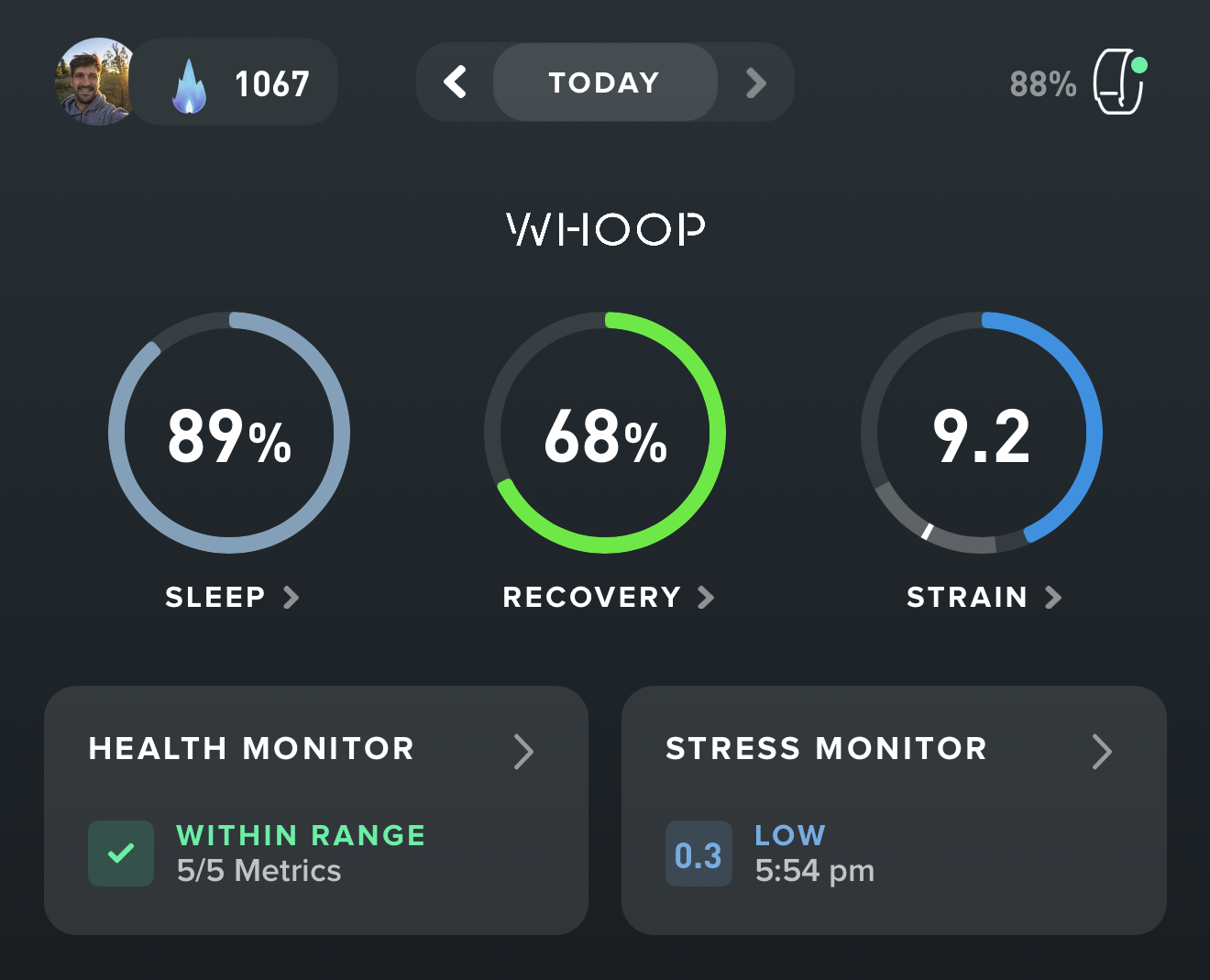
Use Whoop, Garmin, Apple Watch, or Oura.
2. Establish a 7-day baseline
Don't change anything yet. Just observe.
3. Set your standards
Pick realistic improvements based on where you are.
4. Review weekly
Small adjustments beat big heroic bursts.
5. Watch your energy, strength, and confidence rise
Your numbers become your roadmap.
This is standards-based training. You're not relying on how you feel. You're relying on what's real.
Why This Is Core Four Quadrant One
Strong Body is first for a reason.
Because when your Strong Body improves, everything else follows:
- Your Calm Mind stabilizes.
- Your Clear Purpose sharpens.
- Your Confident Life expands.
Energy is the gateway to every other improvement in your life.
If you want a strong life, start with a strong body.
But don't just guess. Don't just grind.
Track what matters.
What's Next
If this resonates, the next step isn't to track more.
It's to get clear on where you actually are across all four areas of your life.
That's exactly what my Own Your Week Scorecard helps with.
No fixing. No judgment. Just awareness across Strong Body, Calm Mind, Clear Purpose, and Confident Life.
It takes five minutes. And it might be the most honest conversation you have with yourself this week.
Because here's what I know from working with hundreds of high-performing men:
You can't improve what you can't measure. And you can't measure what you won't look at.
Your dashboard tells the truth.
The question is: are you ready to see it?