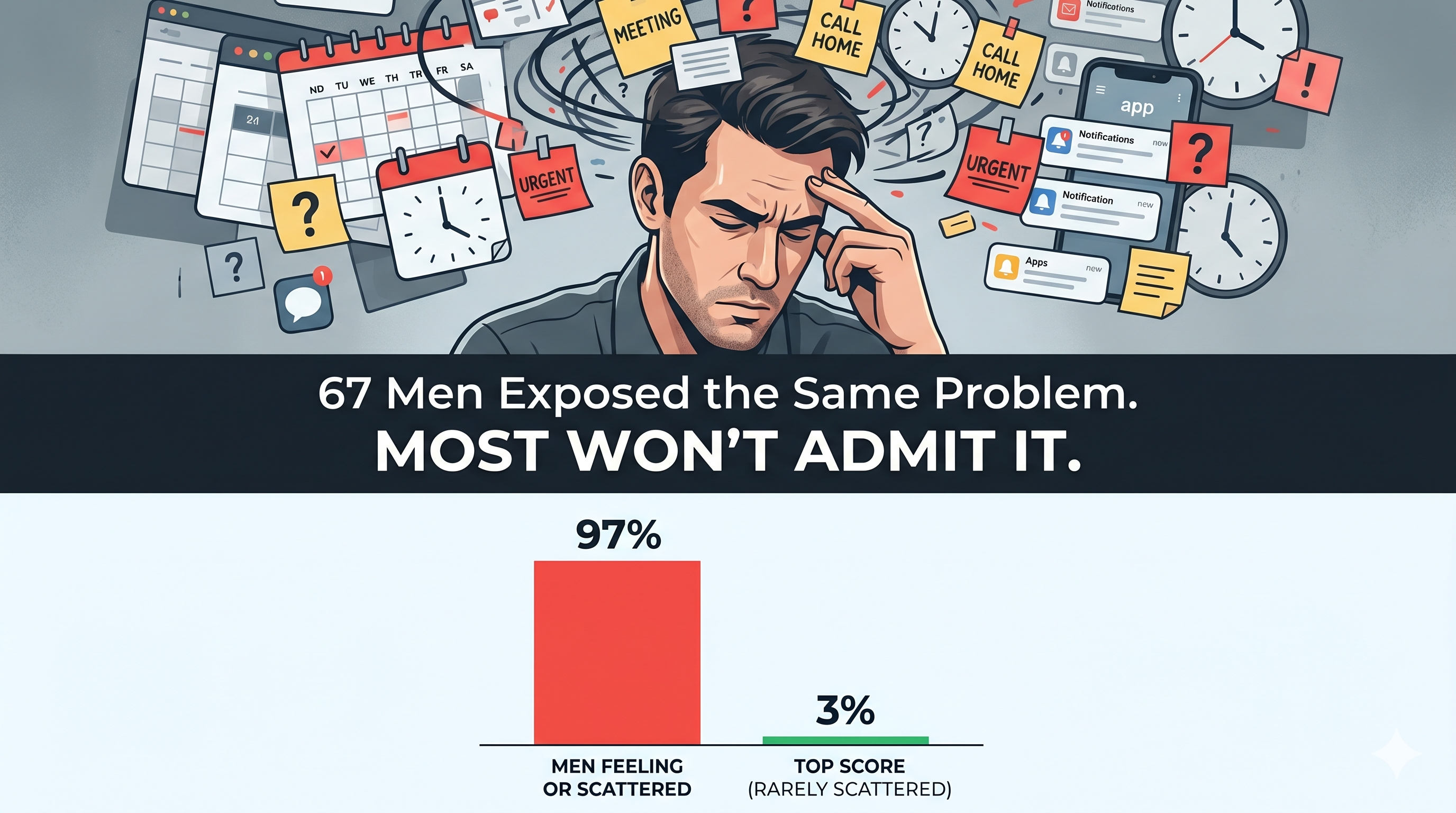
I recently pulled the data from 67 men who completed the Own Your Week Scorecard, and one question stopped me cold.
"I rarely feel overwhelmed or mentally scattered."
Only 3% gave themselves a top score. Three percent.
That means 97% of the men who took this scorecard are carrying some level of mental overload. Not once in a while. Regularly.
22% sat at a 3 out of 10. 16% landed on a 5. And 9% scored at the very bottom, essentially admitting they feel overwhelmed most of the time.
If you're reading this and thinking "yeah, that sounds about right," I want you to sit with that for a second. Because that reaction is part of the problem.
We've Normalised the Chaos
Somewhere along the way, being mentally scattered became a sign you're doing enough. "Yeah mate, flat out." We say it at barbecues. We say it to our partners. We say it to ourselves in the mirror on a Monday morning like it's a badge of honour.
It's not.
Being constantly overwhelmed isn't proof that you're working hard. It's proof that the way you're operating isn't sustainable. And the longer you let that slide, the more it costs you. Your energy. Your patience. Your presence with the people who matter most.
After coaching over 1,200 men across 8+ years, here's what I know to be true: most men don't have a stress problem. They have a margin problem.
The Margin Problem
Margin is the space between your commitments and your capacity. When that gap disappears, everything starts to break down.
No time between meetings. No space to think. No energy left at the end of the day to be the partner, the father, the friend you actually want to be.
So the days blur together. You're busy but not productive. Tired but not resting. Present in the room but not actually there.
I've lived this. During my 58 marathons in 58 consecutive days, there were moments where the physical exhaustion was nothing compared to the mental load. My body could take the hits. But when my mind had no margin, when there was no clarity between what mattered and what was just noise, that's when I nearly broke.
The lesson I took from that experience applies to every man I coach: you don't collapse because of one hard thing. You collapse because you have no space to absorb the hard things.
You don't collapse because of one hard thing. You collapse because you have no space to absorb the hard things.
That's the Margin Method. It's one of the core tools I use with coaching clients, and it sits at the heart of what I call Calm Mind, the second pillar of my Core 4 framework.
Why High Performers Are the Most at Risk
Here's the part that doesn't get talked about enough. The men most likely to feel mentally scattered are often the ones who look like they've got it all together.
The guys earning well. The guys with the family. The guys who are "successful" by every external measure.
They're also the guys running on fumes. Because high performers have a dangerous habit: they raise the bar on output without ever raising the bar on how they manage themselves.
More responsibility. More pressure. More decisions. Same broken system underneath.
I see it constantly. A man walks into my coaching program ticking every box on the outside. Good job. Healthy relationship. Fit enough. But inside? Scattered. Disconnected. Running a life that looks right but feels wrong.
That's the "successful but empty" problem. And the scorecard data confirms it's not rare. It's the default.
What Actually Fixes This
I'm not going to tell you to meditate for 20 minutes or download a productivity app. That stuff can help, but it's not the fix.
The fix is structural.
It starts with getting honest about where you actually are. Not where you think you should be, not where you tell your mates you are. Where you actually are.
That's what the Own Your Week Scorecard is built for. It forces an honest snapshot across the areas that matter: your body, your mind, your purpose, and your confidence. No guessing. No ego. Just data.
From there, it's about building a system around the life you want instead of constantly reacting to the one you've got. That means creating margin. Setting standards instead of chasing motivation. Getting clear on what actually matters this quarter, this month, this week.
Standards are what hold you together when motivation disappears.
That's not a quote I borrowed. It's something I learned running through injuries at 4am in the middle of winter across the US. Motivation didn't get me through 58 marathons. Standards did.
The Real Question
97% of the men who took this scorecard are carrying mental overload. If you're honest with yourself, you probably relate to that number.
The question isn't whether you relate. It's what you're going to do about it.
You can keep wearing the chaos like a badge. Or you can get clear on where you actually stand and start building from there.
Take Action Now
Take the Men's Own Your Week Scorecard and find out where you sit across all four pillars of life performance. It takes less than five minutes, and the clarity it gives you is worth more than another month of running on autopilot.
Cheers
Lachlan Stuart