"Journaling? That's not for guys like me."
I said that in 2014. Believed it, too.
Twelve years and dozens of notebooks later, I've journaled through everything, including 58 marathons in 58 consecutive days. Those pages are some of the most valuable things I own.
Here's what I got completely wrong.
The Real Reason Men Don't Journal
Most men don't avoid journaling because it doesn't work.
They avoid it because they think it's not for them.
Growing up, journaling looked like something made for girls. Colourful notebooks. Emotional processing. Feelings everywhere.
So we never learned how to use it properly. We wrote it off before we ever tried it and that belief quietly shut the door on one of the most powerful tools a man can have.
I was the same. Practical guy. Worked with my hands. Did real work. Journaling? That wasn't in my toolkit.
Then in 2014, I went to a personal development seminar. People kept saying, "You should journal." I kept ignoring them.
Then I saw it done differently.
Not feelings everywhere. Not poetry. Just questions. Thoughts. Plans. Clarity.
Later, I heard Jim Rohn say something that changed everything: one of the greatest treasures you can leave behind is your journals because they show how you thought, and how you became who you became.
That hit different.
So I gave it a go. And over the last 12 years, I've filled journal after journal.
Moments that once stressed me don't touch me anymore. Ideas that were once messy finally made sense on paper. Big goals first appeared in those notebooks long before they became real.
I even journaled every day while running 58 marathons in 58 consecutive days from Alaska to Brisbane. Those notes didn't just help me process what I was experiencing physically and mentally, they're now helping me write a book about the journey.
The Blank Page Effect
This is what I now call The Blank Page Effect.
It’s the moment a man takes what’s been looping in his head and puts it somewhere he can see it.
Not to feel better. To regain control.
"The blank page isn't therapy. It's a control panel. And the man holding the pen decides what matters."
Why It Works (In Real Life)
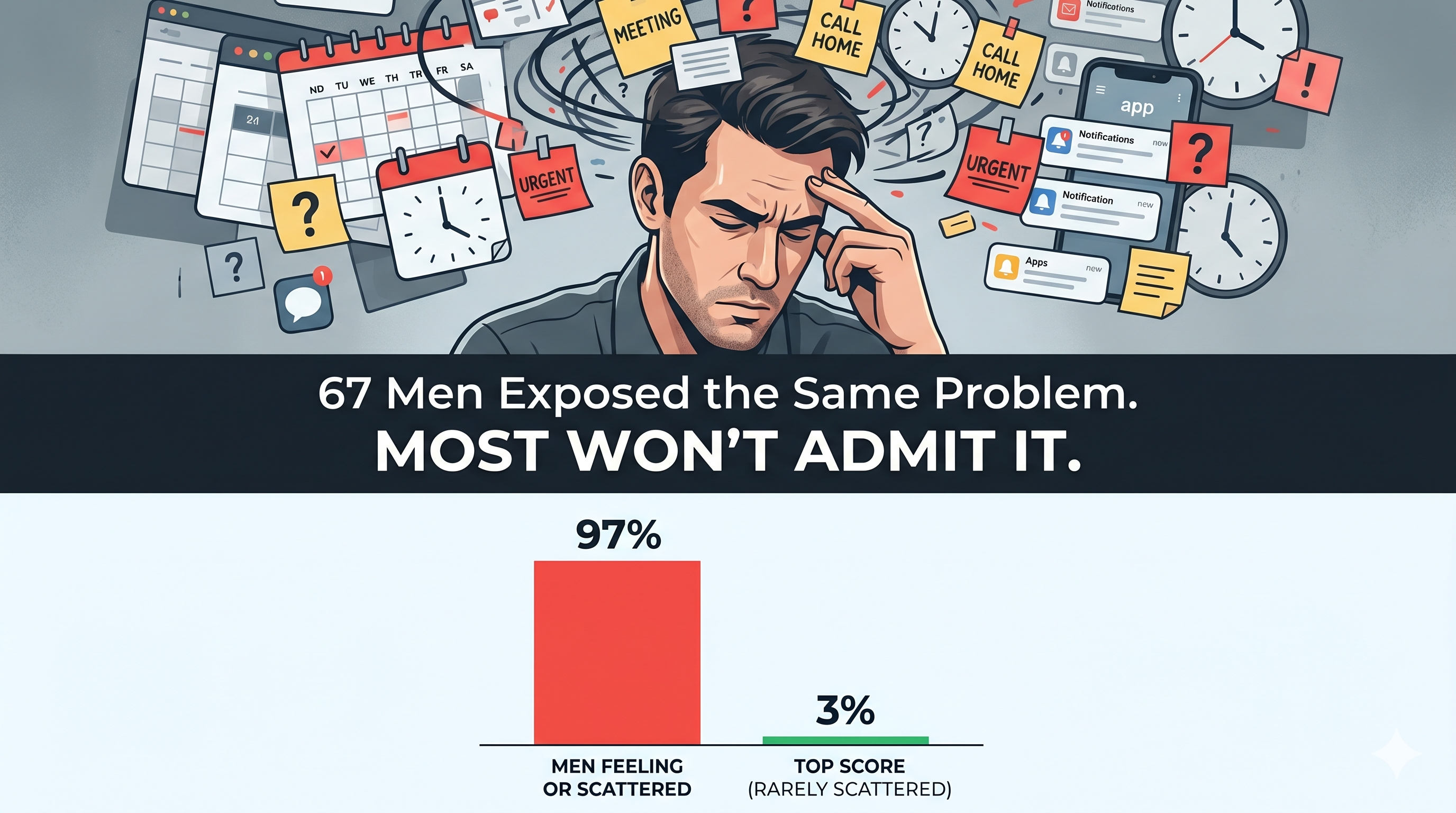
Think of your mind like a backpack you carry everywhere.
Every unfinished thought. Every pressure you don’t talk about. Every decision you keep postponing.
They all go in there.
And most men never take the pack off. They just keep loading it up, until the weight feels normal.
Journaling is taking the pack off and laying everything on the table.
When your thoughts are on paper, they lose their weight. They stop bouncing around your head. You can see them clearly.
And once you can see them, you can decide what matters and what doesn’t.
That’s the Blank Page Effect.
When It Mattered Most
During the 58 marathons, I journaled every night.
Sometimes in motel rooms. Sometimes sitting on the floor of the van with my legs cramping and my body cooked.
There were nights I didn’t write anything profound. Just a sentence like: “Get to tomorrow.”
Those words mattered more than any training plan.
They gave me something simple to hold onto when everything felt heavy. Not motivation. Direction.
That’s what the page does when things get real.
Why Journaling Actually Changes Things
Research shows that writing reduces stress, improves emotional regulation, and increases self-awareness.
But you don’t need studies to understand it.
You feel it the first time you get something out of your head and onto the page.
Here’s what journaling does that nothing else can:
Writing slows thinking down.
Your brain can think faster than you can write. When you write, you’re forced to process one thought at a time. That’s where clarity lives.
Thoughts on paper lose power.
What feels overwhelming in your head often looks manageable on the page. You stop reacting and start evaluating.
You can’t solve what you can’t see.
Most men are trying to fix problems they haven’t defined yet. Writing makes the invisible visible.
This is what I call a Calm Mind, one of the four pillars of my Core 4 framework.
"A calm mind isn't an empty mind. It's a clear one."
And journaling is one of the simplest ways to build it.
There Is No "Right" Way to Journal
Most men say, "I don't know how to journal."
The truth is, there is no right process.
The man holding the pen decides the outcome.
Five minutes or an hour. Questions, lists, goals, stress dumps, planning tomorrow, unpacking yesterday.
It all counts.
Some days I write a page. Some days it’s a paragraph. Some days it’s just bullets.
The point isn’t the format.
The point is the space.
Space to think without interruption. Space to be honest without consequences. Space to decide what actually matters next.
No opinions. No performance. Just you and the truth.
This Is Probably You
You don't need more motivation.
You need space.
You’ve got responsibilities. Pressure. Noise coming from every direction.
What you don’t have is a place to think clearly.
That’s what the blank page gives you.
Not answers. Clarity.
Not motivation. Direction.
What Comes Next
If this resonates, the next step isn't journaling more.
It’s clarity.
Start by seeing where your life is actually strong and where it’s drifting.
That's what my Own Your Week Scorecard is designed to do.
No fixing. No judgement.
Just honest awareness across the four areas that matter most:
Strong Body
Calm Mind
Clear Purpose
Confident Life
It takes five minutes.
And it might be the most honest conversation you have with yourself this week.
Because here’s what I know from working with hundreds of high-performing men:
You can’t improve what you won’t look at. And you can’t lead yourself without clarity.
The blank page is waiting. So is the next version of you.
Cheers
Lachlan Stuart