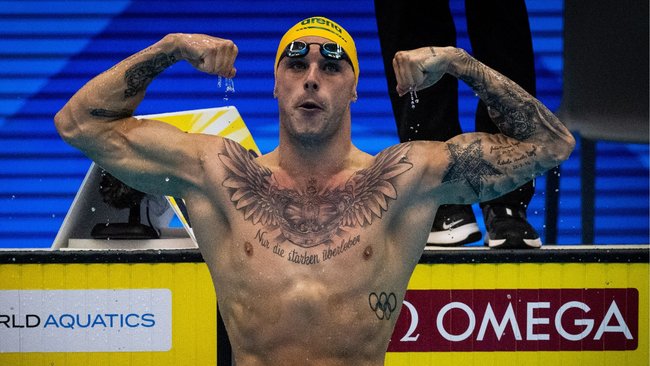
Kyle Chalmers won Olympic gold at 18 years old. He dove into the pool in Rio as an unknown teenager and came home a national hero. Life changed overnight.
What most people don't see is what happened next. The pressure. The scrutiny. Three heart surgeries. A shoulder injury that nearly ended his career. A period where he semi-retired, moved to a country town of 750 people, and worked as a boat mechanic just to find himself again.
I sat down with Kyle and what struck me wasn't the Olympic stories. It was how grounded he is. How self-aware. How committed to being a regular bloke in an extraordinary world. There's something in that for every man trying to perform at a high level without losing himself in the process.
The Obsession With Fundamentals
Kyle lost the Tokyo Olympic final by 0.06 of a second. His reaction time off the blocks was 0.66 seconds. The winner's was 0.60. That's it. That's the margin between gold and silver at the highest level of sport on earth.
Most people hear that and think about talent or genetics. Kyle thinks about turns.
He swims 50,000 metres a week. In a 100m freestyle race, he gets one turn. So every single turn he does in training, he does with intent. Not because his coach tells him to. Because he knows that the gap between first and second is built in the thousands of repetitions nobody sees.
This is what separates high performers from everyone else. It's not the big moments. It's the relentless commitment to fundamentals when nobody's watching and nothing's on the line.
Kyle put it simply: what his coach asks him to do is the bare minimum. Anyone and everyone around the world is doing what their coach asks. It's what you do on top of that.
That's a standards mindset. Not motivation. Standards.
Life Balance Makes You Faster
Here's what surprised me most about Kyle. He labours on a building site two days a week. He breeds reptiles. At one point he had 500 in his collection, including a pet crocodile. He goes fishing on Sundays instead of doing recovery sessions.
And he's one of the fastest swimmers on the planet.
Kyle is clear about why: a happy swimmer is a fast swimmer. He's learned through painful experience that when he cuts everything out of his life except swimming, he burns out. After the 2016 Olympics, he came home, went all-in on training, and within a year was contemplating quitting.
The lesson he learned is the same one I see play out with every high-performing man I coach: you cannot sustain elite output from a depleted life. Your performance in the arena is a reflection of how you're living outside of it.
Kyle's mates on the building site, his reptile collection, his weekends fishing, these aren't distractions from his swimming. They're the reason he can sustain it. They give him an identity beyond the pool, connections beyond the team, and energy that pure training can never provide.
The Heart Condition Nobody Talks About
At 12 years old, Kyle's heart rate spiked while kicking a football with his dad. He got dizzy. Nearly blacked out. And like most young males, he retreated to his bedroom and said nothing.
That pattern continued for years. He was eventually diagnosed with supraventricular tachycardia, an extra circuit in his heart that would trap blood and send his heart rate through the roof without warning. It could happen in training. It could happen in a race. If it happened while he was swimming and he blacked out, he could have drowned.
He had three surgeries. The first one failed. The second provided temporary relief. By 2019, he was in the marshalling room before a World Championship semi-final when it happened again. He sat there, heart racing uncontrollably, hoping it would settle before his race was called. It did. He raced. He was physically and mentally destroyed, and didn't make the final.
Kyle never considered not racing. He'd worked too hard to be there. That's not recklessness. That's conviction.
The condition was finally resolved in 2019 with a third surgery. But for years, every time he dove off the blocks, there was a real chance his heart would betray him mid-race. He performed at the highest level in the world while carrying that weight silently.
Fame at 18 and the Mental Health Reality
Kyle went to Rio as a kid nobody recognised. He came back and couldn't walk through a grocery store without being stopped. Every aisle, another conversation. Every outing, more photos and signatures.
What he said about social media resonated deeply. You can have a hundred positive comments and one negative one, and you'll spend all your energy on the negative. You start stalking the person's profile, seeing they have a wife and kids, wondering why they'd say that. He got caught in that loop for a long time before learning to let it go.
The Tokyo cycle was even harder. COVID uncertainty had people constantly telling him the Olympics shouldn't go ahead. He was mentally preparing for cancellation while simultaneously training to defend his title. He'd just come back from shoulder surgery. He'd barely started swimming properly again in March before a July Olympics.
He won silver. Swam half a second faster than his gold medal race in Rio. And he considers it the pinnacle of his career, because of everything he had to overcome to get there.
That's a perspective most people miss. The value of an achievement isn't just in the result. It's in what you had to go through to get it.
Semi-Retirement and Finding Himself Again
After a year of kicking with a snorkel, watching his teammates do what he couldn't, driving home with shoulders too sore to sleep, Kyle hit his breaking point in February of last year. He was done.
He went home to the country. Worked as a boat mechanic with his cousin in a town of 750 people. Went fishing. Went hunting. Had some beers. Ate badly. Just existed as a normal person for two months.
Then a mate invited him to the Sunshine Coast. He jumped in the pool with a group of school kids who swam for the love of it. No pressure. No expectations. Just swimming.
He fell in love with it again.
That's the pattern I see over and over in coaching. When men burn out, the answer isn't to push harder. It's to step back, reconnect with what matters, realign with your values, and come back with fresh perspective. Kyle didn't need a new training program. He needed to remember why he swam in the first place.
The Takeaway
Kyle Chalmers is proof that elite performance and authenticity aren't mutually exclusive. You don't have to sacrifice who you are to be the best at what you do. In fact, the opposite is true. The more connected you are to your identity, your relationships, and the things that genuinely make you happy, the better you perform when it counts.
If you're a man who's grinding towards a goal and feeling the edges fray, ask yourself Kyle's question: am I a happy person right now? Because if the answer is no, more work isn't the solution. More life is.
Your Strong Body fuels your Calm Mind. Your Calm Mind reveals your Clear Purpose. And when you're living with purpose, you show up to every arena, whether it's a pool, a boardroom, or your living room, as the best version of yourself.
That's what life performance actually looks like.
If you want to bring these lessons to your team or organisation, learn more about my keynote speaking on resilience, mental health, and high performance.
For more conversations with world-class performers, subscribe to the Man That Can podcast.