What Corporations Get Wrong About Building Tough Teams

Lachlan Stuart running in snow in the USA.
Resilience Keynote Speaking: What Corporations Get Wrong About Building Tough Teams
Most companies hire resilience speakers hoping their teams will become tougher.
Then nothing changes.
Burnout still happens. Deadlines still break people. Teams still crumble under pressure.
Why?
Because most corporate resilience training treats resilience as damage control… how to bounce back after you break, how to manage stress before it kills you, how to take a mental health day before you quit.
But here's the problem: resilience isn't tested when things are calm. It's tested when quitting feels easier than continuing.
And that's the distinction most resilience keynote speakers miss.
What Corporations Think Resilience Is (And Why They're Wrong)
If you ask most HR directors or event planners what resilience means, they'll say something like:
"The ability to bounce back from setbacks"
"Managing stress effectively"
"Building psychological safety so people don't burn out"
All of that sounds good.
And all of it misses the point.
Resilience isn't what happens after you break. Resilience is what keeps you from breaking in the first place.
It's not about recovery. It's about endurance.
It's your ability to keep showing up, day after day, decision after decision, even when you're exhausted, even when the goal feels impossible, even when quitting would give you instant relief.
That's resilience.
And you can't build it with a one-hour keynote about stress management.
I've spoken at company conferences where the leadership team brings me in expecting a motivational fix. They want their people to be tougher.
They want resilience. But when I ask them, "What's the goal your team is working toward?" they pause. They don't have one. Or they have five conflicting ones. Or they have a vague mission statement no one actually believes in.
That's the problem. You can't build resilience without a North Star. You're just asking people to suffer harder for nothing.
The Day Resilience Was Actually Tested
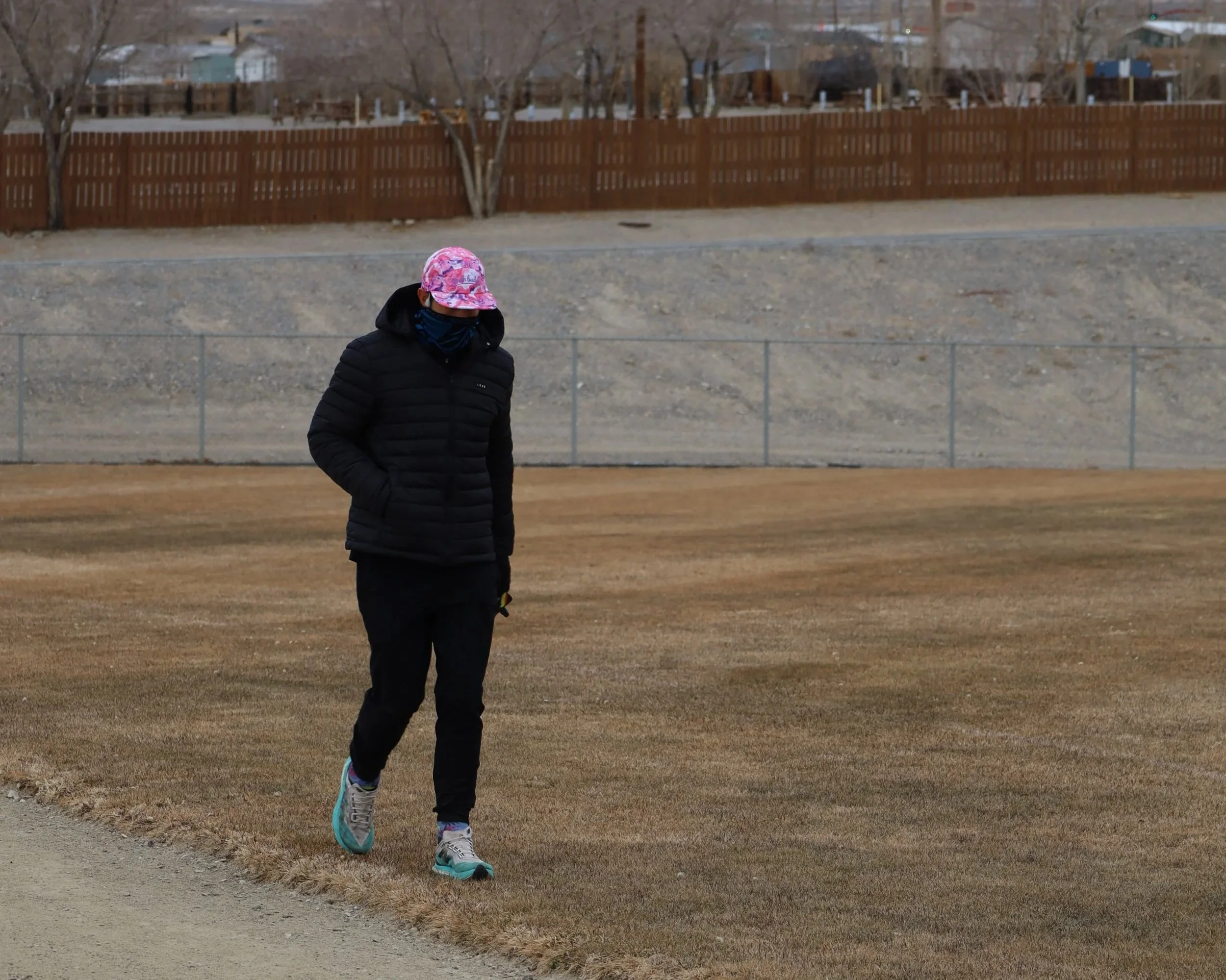
Lachlan Stuart on marathon 5 in West Wendover, Nevada.
Let me take you to West Wendover, Nevada. Day 5 of my 58 marathons in 58 days challenge.
It's -12°C outside. I've been running a marathon every single day for five days straight. My right toe is injured. Then my right ankle. Now my left ankle. The pain is getting worse, not better.
I wake up, put my feet on the ground, and a burning sensation shoots up my shins. I nearly throw up.
I think: I can't do this today.
I walk over to a baseball field, wearing tracksuit pants, thermals, a jacket, a face shield, and a hat, everything I can layer on to keep warm. The wind still cuts through.
And I start walking laps.
Hoping my ankles warm up enough that I can start running again.
But they don't.
And my brain starts doing what brains do under pressure: it attacks.
Who do you think you are?
You're not capable of this.
You injured yourself because you're stupid.
You should quit.
For a couple of kilometers, I believed those thoughts.
Then I realized something:
I had a choice.
The Resilience Loop: The Framework Corporations Need (But Don't Use)
Here's what I learned on that freezing baseball field in West Wendover and what I now teach corporate teams:
Resilience isn't built through motivational speeches or stress management workshops.
It's built through three simple steps. I call it the Resilience Loop.
Step 1: Choose Your North Star (The Goal)
Before you can be resilient, you need to know what you're being resilient for.
On Day 5, my North Star was clear: complete 58 marathons in 58 days and raise $100,000 for the Mental Awareness Foundation.
For a corporate team, the North Star might be: launch the product by Q2, hit the revenue target, deliver the client project on time.
Without a clear goal, resilience is just suffering for no reason.
With a clear goal, resilience becomes meaningful endurance.
Step 2: Understand Your Choices (What Moves You Toward or Away From the Goal)
Standing on that baseball field, I had two choices.
Choice 1: Quit. Get instant relief. Stop the pain.
But the consequences? I'd have to call my sponsors and the charity. I'd have to tell everyone on social media I failed. And worst of all, when I put my head on the pillow that night, I wouldn't be proud of the man I'd become.
Choice 2: Keep going. One foot in front of the other. No guarantee I'd finish the day, let alone the next 53 marathons.
But the consequences? I'd live to fight another day. I'd raise more money for mental health. And when I put my head on the pillow, I'd be proud of who I was becoming.
Every choice has friends. Those friends are called consequences.
The same is true in corporate teams. Every decision your team makes either moves them toward the goal or away from it.
The question is: Do they know which is which?
Step 3: Stack Small Wins (Focus on the Next Step)
When you're overwhelmed, you can't think about the entire marathon. You can only think about the next step.
On Day 5, I couldn't think about 53 more marathons. I could only think about the next kilometer. Then the next one. Then the next one.
That's how resilience works.
You don't need to be strong enough to finish the whole project today. You just need to be strong enough to take the next small step.
Goal → Choices → Small Wins.
That's the Resilience Loop.
And it's what separates teams that collapse under pressure from teams that endure through it.
Why Most Corporate Resilience Training Fails
Here's what I see when I work with companies:
They bring in a resilience speaker. The speaker talks about stress management, mindfulness, mental health days. Everyone nods. Everyone feels inspired for 48 hours.
Then nothing changes.
Why?
Because resilience training without a goal is just theory.
You can't build resilience in a vacuum. Resilience is only tested in relation to something that matters.
If your team doesn't have a clear North Star… a goal worth grinding for, then no amount of resilience training will help.
They'll just burn out faster.
The Difference Between Individual Resilience and Team Resilience
Here's another mistake corporations make:
They assume that if you build resilient individuals, you'll automatically have a resilient team.
Not true.
You can have a team full of individually resilient people who collectively fall apart under pressure.
Why?
Because team resilience requires ownership, roles, and accountability.
On the 58 marathons challenge, there was a day, around Day 18 or 19, where I was completely depleted. I couldn't think straight. I was forgetting things. I was overwhelmed.
So I called a meeting with my team and said:
"I need help. I can't fill my water bottles. I need you to create a checklist. I need you to handle logistics, accommodation, food, gear. All I can focus on is running."
And they did.
The team took ownership. They knew their roles. And because of that, we finished the challenge.
That's team resilience.
It's not about everyone being tough all the time. It's about everyone knowing their role, owning their part, and supporting each other when someone's at their limit.
If you don't have clear ownership and accountability, even the most resilient individuals will start to drift, disengage, or burn out.
What Resilience Actually Looks Like in Corporate Teams
Real resilience in corporate teams looks like this:
✅ A clear goal that everyone understands and believes in
✅ Defined roles so everyone knows what they own
✅ Accountability so people feel pride in their contribution
✅ Support systems so when someone's struggling, the team steps in
✅ Progress tracking so you know if you're moving toward or away from the goal
Resilience without structure is just chaos.
Resilience with structure is endurance.
Why Stress Management Isn't Enough
Let me be clear: stress management, mindfulness, and mental health days are important.
They're the recovery periods. The recharge. The reset.
But resilience isn't built during recovery. It's built during pressure.
And there are times, especially when you're close to a deadline, close to a breakthrough, close to something that matters, when you can't take a mental health day.
You have to grind through.
I would have loved mental health days during the 58 marathons. But if I'd taken them, I wouldn't have finished.
The question isn't whether stress management is valuable. The question is: what happens when there's no time for it?
That's when resilience is tested.
And that's what corporate teams need to be prepared for.
Men Need a Mountain (And So Do Teams)
I believe men need a mountain.
Without a big challenge, something that demands everything you've got, you drift. You coast. You settle.
The same is true for teams.
Teams need their own mountain. A goal big enough that it requires resilience. A challenge that forces ownership, accountability, and growth.
Without a mountain, teams become bureaucratic. They manage tasks. They avoid risk. They play it safe.
With a mountain, teams become resilient. They solve problems. They take ownership. They endure.
The question for your team is: what's your mountain?
What to Look for in a Resilience Keynote Speaker
If you're hiring a resilience speaker, here's what to look for:
✅ Look for speakers who've lived resilience (extreme challenges, real pressure, documented endurance)
✅ Look for speakers who give you a framework (not just inspiration, but a system your team can use)
✅ Look for speakers who connect individual resilience to team resilience (because one without the other fails)
The Lachlan Stuart Difference
I'm not a motivational speaker who read about resilience in a book.
I'm someone who lived it.
58 marathons in 58 consecutive days. Injured ankles. -12°C weather. IVF struggles with my wife. Mental breakdowns. Logistical chaos.
And I didn't just survive it. I broke it down into a framework that works for individuals and teams.
The Resilience Loop: Goal → Choices → Small Wins.
I bring that framework into keynotes, workshops, and corporate training. And I do it with emotional honesty, lived experience, and a system your team can actually use.
I'm still in the game. Still chasing world records. Still testing resilience in real time.
And that's the difference.
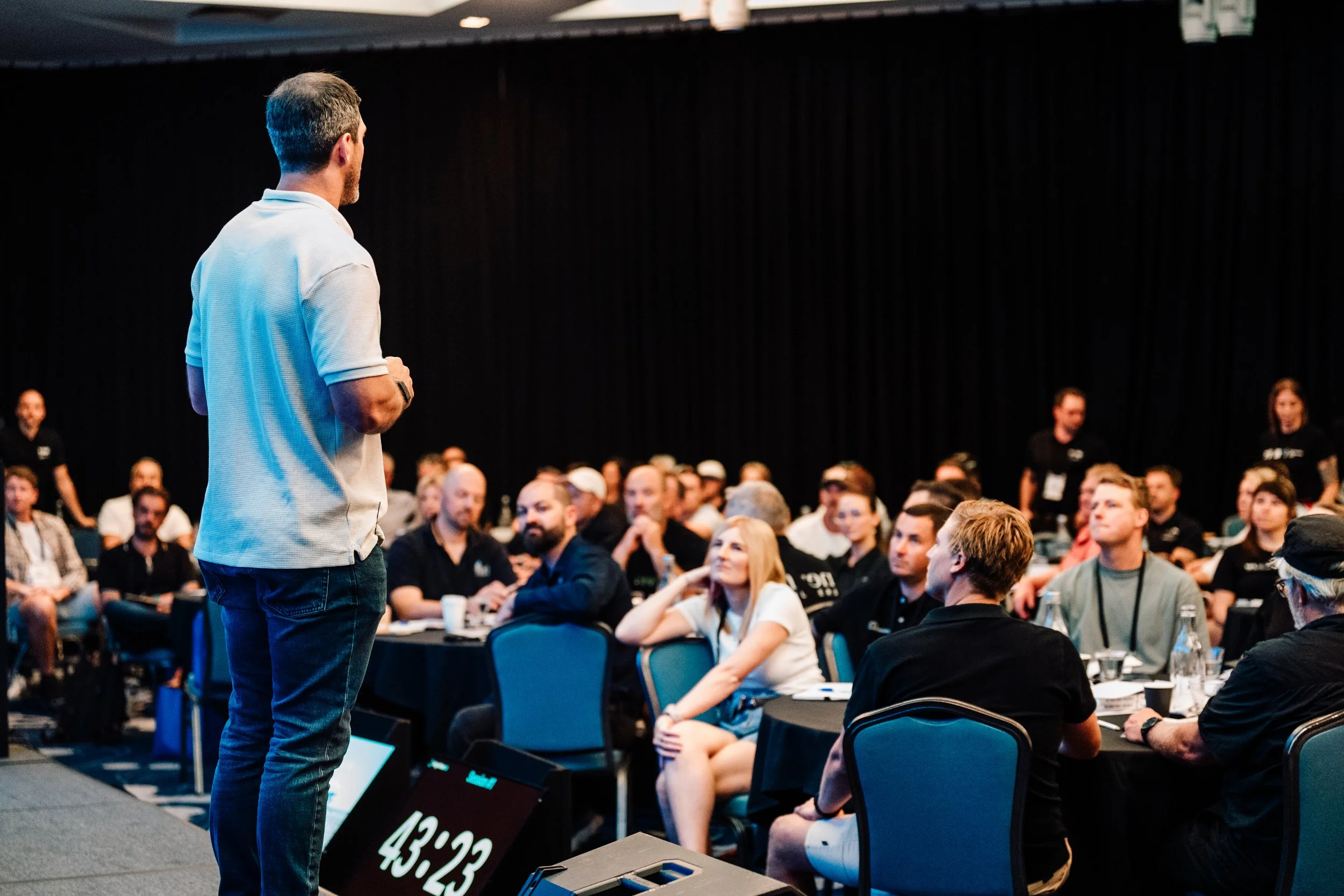
Lachlan Stuart Delivering a Mental Resilience Keynote.jpeg
What Happens After This Blog
If this resonated with you, here's what to do next:
Watch my keynote demo to see how this framework comes to life on stage
Visit my speaking page to learn more about booking me for your next event
Share this blog with your HR director, event planner, or leadership team
Resilience isn't built through one-hour speeches about stress management.
It's built through clarity, ownership, and a goal worth grinding for.
If your team needs that, let's talk.
Thanks for reading.
Lachlan Stuart
Lachlan Stuart is a resilience keynote speaker, endurance athlete, and Life Performance Coach. He ran 58 marathons in 58 consecutive days, raising $161,000 for mental health, and now helps corporate teams build real resilience under pressure through his Resilience Loop framework.